

sociologist Allison Daminger on the mental load of early parenthood
sociologist Allison Daminger on her new book WHAT'S ON HER MIND, how her research prepared her for early parenthood, and a chance to win her book!



Hello there! Welcome to Write More, Be Less Careful, a newsletter about making space for creative practice in a busy life. If you’ve found inspiration in the good creatures series, I think you’ll love my new book, The Good Mother Myth, about motherhood, ambition, and making art.
This is a good creatures interview, a series that explores the intersection of caregiving and creative practice. If you know (or are!) a good creature whose work we should feature, send me an email—you can just reply to this newsletter.
Today’s interview is with sociologist Allison Daminger, whose great new book, What’s On Her Mind: The Mental Workload of Family Life, is out next week. I suspect lots of you are already, like me, Allison Daminger mega-fans, but if you’re not, here’s the idea from her life that’s really changed my life (and marriage, tbh!) for the better: what we think of as “mental load” is really four parts: anticipating, identifying, deciding, and monitoring. So the work of getting your kid to soccer practice isn’t just the drive to the field—it’s also remembering when practice is, knowing where the cleats and shinguards are, coordinating a carpool, and so on. It’s why having your partner take the kid to soccer practice doesn’t actually help you feel less overwhelmed, if you’re still tasked with remembering to wash the soccer socks and shorts, finding the water bottle, and texting other parents about the schedule.
Allison’s work has meant so much to me, and I was so honored when she reached out to me this spring, just before the Wisconsin leg of my Good Mother Myth book tour, to say she wanted to talk about my book. You can read that conversation here:

I’m sure you’ll see Allison’s book lots of places in the next couple of weeks, but for now, I’ll say that I really loved the rich examples from her research and the way she positions our difficulties with the gendered distribution of cognitive labor squarely within broader social structures.
If you want to talk more and you’re in the PA/south Jersey/central Jersey area, I’d love for you to join Allison and me in conversation at Princeton Publication Library on Thursday, September 23!

Below, we talk about how Allison’s research prepared her and her husband to be really intentional about the cognitive load of early parenthood (Allison’s a new mom!), why she’s embracing “creative” as part of her identity, and how having a baby is changing her writing life. (And scroll down to the bottom for a chance to win a copy of her new book!)

Who do you care for?
Most of my care-giving energy these days goes to my 5-month-old daughter. Though we are lucky enough to have full-time childcare for her, she still occupies a large portion of my time and an even larger portion of my brainspace! I’m trying to save a little bit of that time and brainspace to care for my dog, who’s been bumped down the hierarchy and isn’t especially happy about that; for my partner, who’s in the midst of some challenging (but exciting) career transitions; and for myself. (I’m probably doing the worst on that last one, but I’m working on it!)
What kind of creative work do you do?
For a long time I felt uncomfortable describing my work as creative. I’m a sociology professor, and in some academic circles there’s a sense that “creative” is in opposition to “rigorous” or “objective.” These days I wear the creative label much more proudly. Dreaming up new research projects is a creative act, as is engaging in deep dialogue with my interview participants, and of course writing papers and books that weave together their stories with existing academic literature. I always collect way more data than I can use in any given book or paper, so figuring out what THE story is, and how to frame it in a way that’s both true to the data and interesting to potential readers, is one of my most common (and difficult) creative challenges.
That said, I sometimes feel constrained by the strictures of academic writing, so I started a newsletter a few years back. I often write about the same topics on The Daminger Dispatch as I do in peer-reviewed academic journals - power, labor, gender, families, etc. - but I like that the newsletter provides space to play with different voices and formats and to explore topics without committing to a years-long research process.

What are some creative milestones you’re looking forward to? Or ones you “missed” due to the both/and aspects of your life?
I’ve been a reader and a book nerd for a very long time now, so there are all sorts of published-author things I’m eagerly awaiting this Fall (or will have just recently experienced, by the time this comes out). I’ll be at bookstores discussing my work with interesting people (like you, Nancy!), connecting with readers at signing tables and through Q&As. And of course I’m excited about that very 2020s flex of displaying my own book in my Zoom background ;)
That said, I’ve had to curtail my ambitions for this particular book launch given my new caregiving responsibilities. Some of that is travel-related: my daughter is still so little, and still such an erratic sleeper, that I don’t want to be away from her for long. Some of it is also about coming up against the limits of my newly constrained time and energy. More on this below…
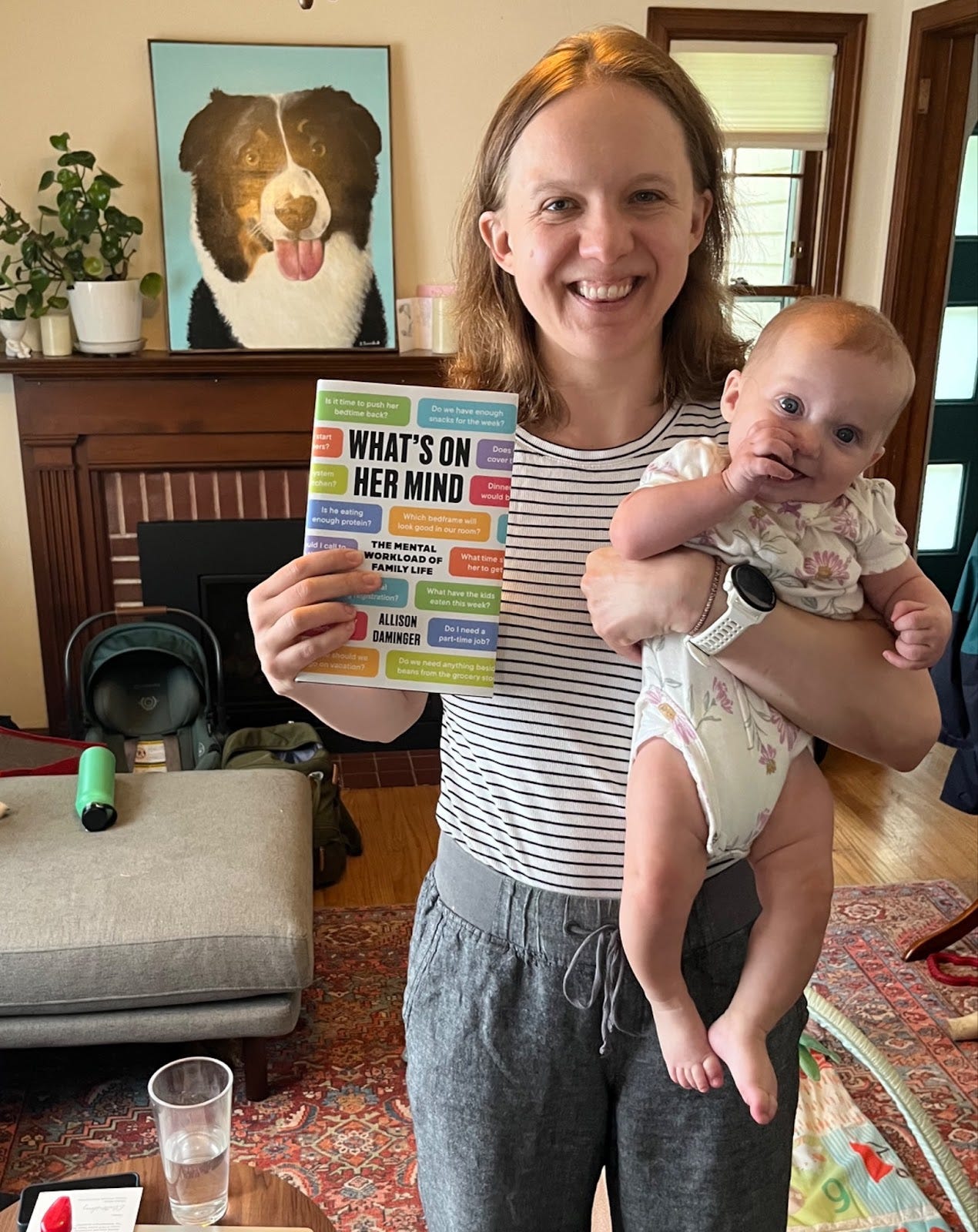
What’s changed in your creative life since becoming a caregiver?
There was always a gap between what I wanted to do in a given week and what I was able to accomplish. Since becoming a parent, that gap feels more like a vast chasm. I’m acutely aware of the opportunity costs associated with any choice I make about how to spend my time and energy: every hour I spend on work is an hour I’m not spending with my daughter, or sleeping, or exercising, or any number of other things. That was always true to some extent, of course, but before parenthood there was a lot more margin for error. I didn’t have to be quite so ruthless about making choices.
Sadly, my efforts to find the ABSOLUTE BEST WAY to spend the hours I have childcare sometimes leave me paralyzed with indecision. Plus, striving for maximum productivity is often anathema to the creative process. If I spend an hour freewriting, or perusing books that are only tangentially related to my research topic, I may not make any tangible progress on the metrics that matter for tenure and promotion. But those zigs and zags are absolutely part of the creative process!
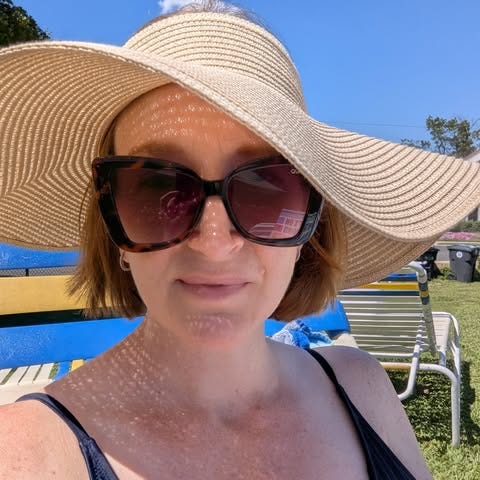
with my copy of What’s On Her Mind at our local pool this summer—Allison’s is the rare academic book that’s also a great pool or beach read! 😎
My creative and scholarly work did, however, set my partner and I up to be very, very intentional about how we handle the transition to parenthood. And it exposed me to all kinds of ways one can be a parent, which has been helpful as I figure out how to navigate this new relationship with my daughter.
What are some ways care-giving fosters creativity and vice versa?
My very anecdotal sense is that researchers and artists often come to the topic of parenthood and care-giving after they have a child or take on other significant care-giving responsibilities in their own life. It was the opposite for me: I started studying unpaid labor, care work, and the mental load before I had a partner or any dependents. I was, among other things, curious about what care-giving - and particularly care-giving with another person - was like, and whether it could be done in a way that didn’t overburden women. And I’ll admit that my research did not necessarily make me more excited to become a mother! My creative and scholarly work did, however, set my partner and I up to be very, very intentional about how we handle the transition to parenthood. And it exposed me to all kinds of ways one can be a parent, which has been helpful as I figure out how to navigate this new relationship with my daughter.
In the other direction, I’ve been pleasantly surprised at how generative the experience of pregnancy and now early parenthood has been for my scholarship and writing. I’ve got a growing backlog of ideas for new research projects and newsletter essays, many of them directly inspired by my experiences navigating prenatal care, struggling to breastfeed, and trying to figure out how to co-parent equitably. I also feel like I can connect more deeply with the parents I interview.
another writer on early motherhood as a creatively generative time

What’s an adjustment you’ve had to make to your creative process, and an adjustment you refuse to make?
I am working (reluctantly) on learning how to write under a wider set of conditions. Pre-baby, I had very specific requirements: I wrote first thing in the morning, alone in my office with my white noise machine blasting and my phone on do not disturb. Some days I can still follow that routine, but many other days I need to compromise on some pieces. Maybe I got a terrible night of sleep, so I need to start the work day with easy tasks and get to harder writing stuff in the afternoon. Perhaps my daughter is sick and needs to be picked up early, so I need to fit writing in around her (still unpredictable!) nap schedule. And I don’t want to be too hard to reach, lest something be wrong with her that I need to know about.
Talk to me in a few years, and I may have ceded more ground, but for now I’m staying firm in a) not working - at least on anything meaningful - past 8pm, and b) single-tasking my deep work, by myself, rather than attempt to do it while paying intermittent attention to my daughter. I imagine some people are better about toggling, but I’d prefer not writing over pretending to write and getting nowhere.
Allison Daminger is an assistant professor of sociology at the University of Wisconsin-Madison. Her first book, What’s on Her Mind: The Mental Workload of Family Life, has just been published by Princeton University Press. You can buy it wherever books are sold, and if you happen to be near Madison, Milwaukee, Chicago, Princeton, Boston, or Philly, you can hear Allison talk about her work live this Fall. Allison also writes a weekly newsletter, The Daminger Dispatch, all about the ways gender shapes our closest relationships.

🎁 comment to win a free copy of What’s On Her Mind 🎁
I was lucky enough to end up with both a paperback ARC and a finished hardcover (thank you, Princeton UP!) and I would love to send the hardcover* to a reader. To be entered to win, tell us: what’s on your mind?
*alas, international shipping is expensive, so I can only send within the US. But, international readers, you’re still welcome to join the conversation!
Write More, Be Less Careful is a newsletter about why writing is hard & how to do it anyway. I’m so glad you’re here.
If Write More has helped you in your creative life, you can support me by sharing it online or with a friend, or by ordering my new book, The Good Mother Myth.

 | A guest post by
|
I loved reading about the steps involved in the mental load — it illuminated so much of what I tackle as a parent of two kids (9 & 5). And I’m also a writer, and am always eager to hear how moms wrangle the creative life. It took me much longer than Allison to realize that toggling between parenting and writing is a recipe for stress …
I spent a lot of time journaling about my hesitancy around calling myself a Creator when I was pregnant. After my daughter was born, it felt more natural than motherhood sometimes. Not easier to manage but easier to identify with after making, birthing, and sustaining a human. Looking forward to this book!